
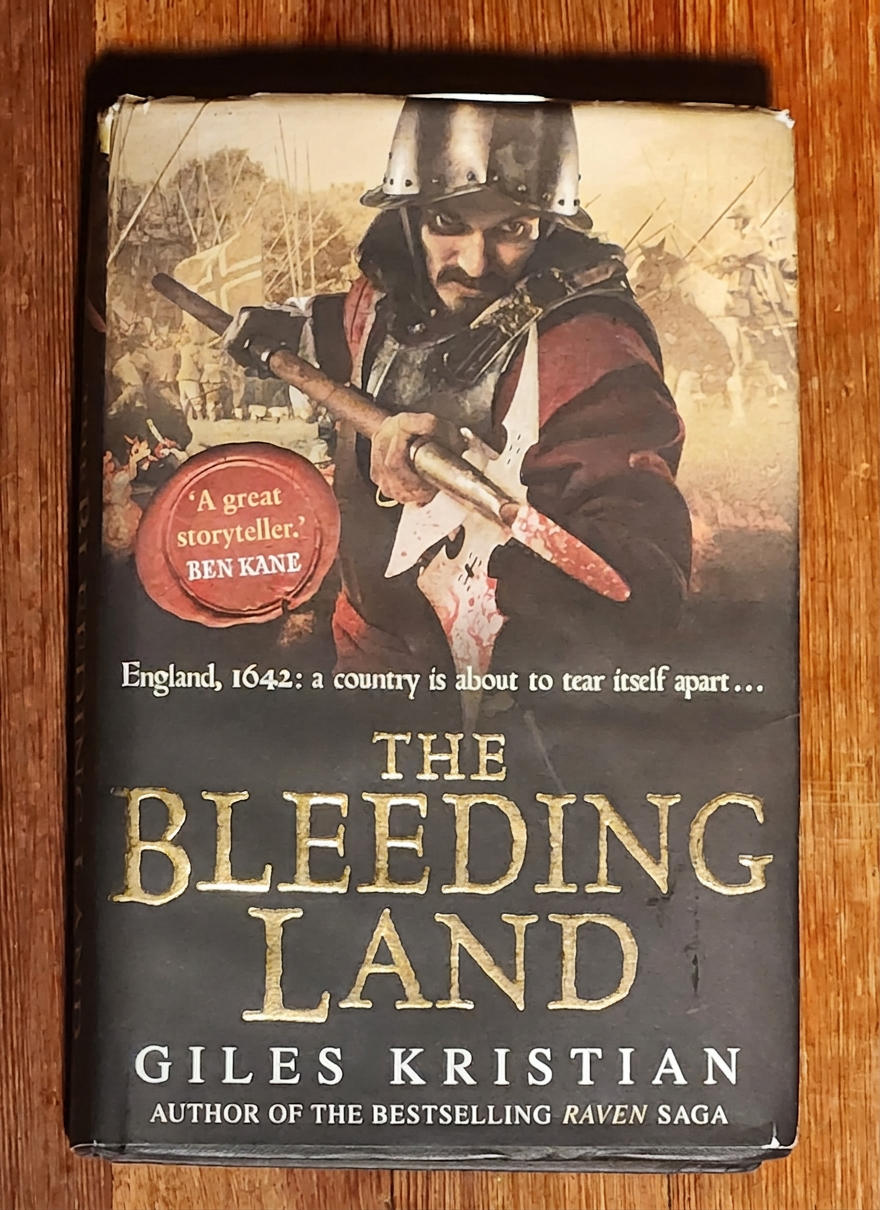
REVIEW OF GILES KRISTIAN’S THE BLEEDING LAND

If you grew up in the United States and attended public school, you got an earful of Abraham Lincoln and the Civil War. If you also watched a lot of TV shows and movies, you took in a lot of stories about World War II. There is good reason for this. Both of these wars are pivotal historical events. One can also make an argument that in each case, there are clear good guys and clear bad guys.

Historians and college sophomores may refute you and start listing facts about how the American Civil War wasn’t really about freeing bonded servants and the allies in World War II made plenty of money off arms sales to both sides and even caused that catastrophe to happen in the first place. These points, however, will always fail to overcome the popular perception that these wars were about fighting the evils of slavery and mass murder, and these events will always thus be fodder for straightforward stories enjoyed by all, if at times, and with the less articulate efforts, between yawns.

Yet there are other segments of history’s vast tapestry that do not lend themselves as well to fairy-tale perfect interpretations. Times where major factions in conflicts don’t so clearly hold the moral upper hand. Situations where those who champion a given tender ethic do so while keeping a boot on the neck of the weak. Times where the oppressed wave the banners of golden yet cruel-hearted figures with, as Yeats put it, “passionate intensity.”

In 1642, a small island nation in the North Atlantic experienced its own brutal episode known now as the English Civil War. Oliver Cromwell, a petty aristocrat turned religious zealot, led a puritan-inspired rebellion against the purported tyrant-king, Charles I. Cromwell theoretically championed a democratic parliament against a leviathan of a monarch who unfairly taxed and controlled the country’s citizens. The king also stood accused of infringing on religious freedoms. His detractors alleged he condemned puritans who wanted to reform Christianity into a belief system that stripped away formal institutions and stated a desire for a more direct relationship between humanity and the divine.

On the other hand, in order to achieve his success, Cromwell invented something called The New Model Army, a fighting force of stalwart soldiers with their hair clipped short, their armor fixed to a clone-like standard, and their cannons and muskets aimed at their infidel enemies. Beyond King Charles and his armies, these included Christian denominations they held in contempt (so much for religious freedom). One might say it was as close to a robot army as the Seventeenth Century could produce, which earned their epithet, the “roundheads.”

In opposition, the so-called tyrant king and his Royalists rode about the countryside with the king’s nephew, the dashing Prince Rupert. Rupert’s men were called “cavaliers,” and with their pop-star fabulous long curly hair, feathered hats, and deadly accuracy with a carbine, they championed the right for Britain to keep its swagger, drink ale on Christmas, and generally rock-and-roll.

Nineteenth Century artist William Shakespeare Burton illustrates the contrast between the war’s opposing cultures in his painting, The Wounded Cavalier (or as I like to call it, “A Rocker’s Good for a Fling as Long as You’re Married to the Iron Fist of the Winning Side, Praise Be!”)
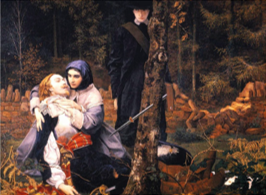
Ironically, it is the conservative “rebel” who holds his sword as if castrating the wild and crazy soldier of the “oppressor.” Yet, both sides in this conflict have their brands of love for authority.

As long as you recognized King Charles was boss and favored his brand of religious oppression, you could ride with the freewheeling(ish) cavaliers.

And if you didn’t, you could join the Parliamentarians…

…as long as you recognized Cromwell and The New Model Army as boss, fought those who they dubbed heretics, and loved the freedom to enforce strict dress codes and austere morality.

Author Giles Kristian’s novel The Bleeding Land paints a literary portrait of such gray ethics in vivid color. The first in a series of historical novels set during the famed Seventeenth Century conflict, the story focuses on a family of Royalists, Sir Francis and Lady Mary Rivers, their sons Edmund and Tom, and their daughter, Bess.

The story begins with parliament’s handling of the Grand Remonstrance, a document drafted by King Charles’ opponents detailing their grievances and accusing him of abuse of power. Though it may be said this document is the spark that lit the war’s powder keg, the story does not dwell on the details of the politics. There being no clear example of mass murder or enslavement as mentioned above, the author instead focuses on the family’s personal stories set against the erosion of British culture’s sense of law and civility.

Kristian plants the seeds of a brother-against-brother plot wherein younger Rivers brother Tom is insulted and attacked by another noble family, the Dentons. Lord Denton has a low-level clergyman executed based on accusations of practicing the wrong kind of Christianity. Said clergyman happens to be the father of Martha, Tom’s beloved. When Denton commits a second atrocity by assaulting Martha and causing her to take her own life, Tom becomes bent on revenge.

The novel draws a clever arc of conflict within conflict. While Sir Francis Rivers and his family rally to the Royalist cause once the king rejects the Grand Remonstrance, it is not loyalty to politics that causes one among them to defect to the Parliamentarian camp. Instead, Tom Rivers simply wants to destroy the Royalist lord who took away the love of his life.

The author might have chosen a plotline more overt in its political ethics. Similar to “good guys versus bad guys” plots common to stories about the American Civil War or World War II, he might have simply painted either King Charles or Oliver Cromwell as a heinous villain to evoke the audience’s sympathies. But such a story would neither be true to history nor as effective as a study of human behavior in a time of complex political ethics.

Instead, Tom Rivers chooses to rebel against the crown not for the sake of establishing a more righteous society, but rather, to inflict pain on those who wronged him. We experience the tension between the even-tempered and purportedly responsible father, Sir Francis and his loyal older son, Sir Edmund, and the younger Tom Rivers who forces all to reckon with the primacy of emotion over reason.

Tom’s rage serves not only to make him a kind of “anti-hero,” but also casts a grim mirror on the romance of the cavalier culture of aristocratic England. The fact Lord Denton can commit a brutal assault on Martha without facing any legal consequences calls into question whether there was any “reason” in such a system in the first place. As the story develops and the opposing brothers prepare for the climactic battle of Edgehill, the audience can justifiably believe that Tom’s rage is a reasonable reaction to a corrupt system.

Yet the Parliamentarians do not possess a monopoly on the audience’s sympathies. While the men of Shear House are away from home with their armies, Lady Mary and daughter Bess face a siege of their own. A small parliamentary force led by a captain Miles Downing demands to seize their home and steal their resources. They seek not only to capture the aristocrats’ assets, but the livestock and property of the farmers on the surrounding lands. Lady Mary organizes a defense not just for the house and her pregnant daughter Bess, but also to protect the local community from lawlessness and plunder.

While The Bleeding Land does not delve deeply into the religious conflicts and prejudices of the time, it succeeds in depicting characters beset on all sides by a deluge of socio-political complexities. One gets the sense that the details of the grievances between king and parliament are themselves a kind of villain. The political arguments eat at the characters’ souls, and by the time the Battle of Edgehill occurs, most of those fighting appear to be doing so for personal reasons that take priority over philosophical ideals (though part of the tension, as exemplified by older son Edmund’s unwavering loyalty to the king, is that he is still motivated by a sense of honor; he does his duty despite showing his rebel brother certain mercies that would be considered treasonous).

The novel proves that the psychological dilemma of choosing between two potential oppressors leaves little room for hundred-percent happy endings. If there is any consolation, however, it also offers keen insight into the human capacity for love and heroic action in the face of the tragic. I propose that we might even seek out the study of such periods in history as a more useful analogue for contemporary America than using the same old villains over an over again and trying to fit them into our discourse. How tiresome has it become that no matter what point of view we take in a political debate, the other side is always Hitler?

For the sake of those who may consider reading The Bleeding Land, I will not discuss the ending here. Suffice it to say, Kristian sustains the sense of ambiguous ethics throughout the entirety of the story, while still offering satisfying conclusions arrived at by the characters themselves. Perhaps that is all any of us can hope for when seeking justice, to know that we can find what is right within our hearts, if not always without.

Carl R. Moore is the author of Slash of Crimson and Other Tales, Mommy and the Satanists, Chains in the Sky, and Red December, published by Seventh Star Press. He has published numerous short stories in magazines and anthologies, most recently with Jumpmaster Press and Crystal Lake Entertainment.
ON ROMANTICS, SPLASH, THE EXORCIST, AND TOP TEN WAYS PORTLAND MAINE WAS DIFFERENT IN THE 1990s

Passing through Portland Maine for the first time in two years got me thinking about my old novella Slash of Crimson and Other Tales which was published way back in 2017. 2017 isn’t all that long ago, but the story takes place in the Portland of the early 1990’s. I originally wrote it during a frustrating time in which a full-length novel manuscript had a near-miss being published by a mainstream publishing house. I had even travelled to Salt Lake City Utah for the World Horror Convention in 2008 to meet my agent and other authors he represented at a client dinner. The trip was educational and I met a lot of interesting folks. The agent’s efforts were appreciated, but didn’t yield results on this first round. So I ended up adrift in some doldrums about what kind of themes broader audiences wanted. I started writing Slash in a coffee shop in Albany New York in part as a satire of paranormal romances like the Twilight series. The idea was to write a story that started out as a romance then had everything crash and burn in the flames of hell.

So much for charming the romantics.

But this new novelette got published by a man named Armand Rosamilia, who at the time had an e-book company in the early days of e-books called Rymfire Books. He published a version of it with a demon-mermaid on the cover drawn by my wife Sarah and it was cool to have an indie-title out that people seemed to get a kick out of (the Splash meets The Exorcist with an unhappy ending—unless you’re the demon…).

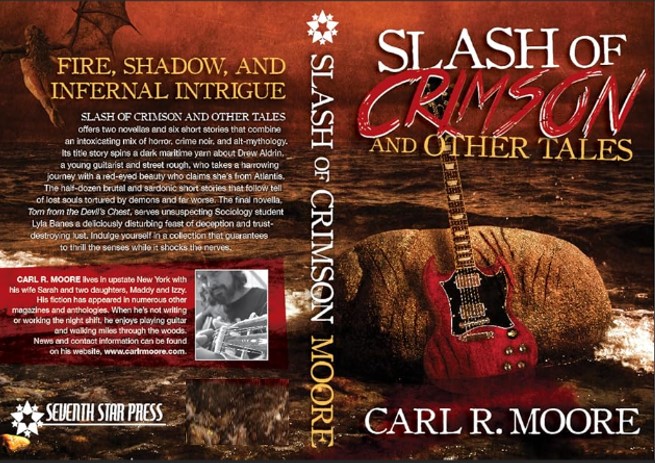
I went back to querying mainstream agents and submitting short stories to anthologies. After attending another World Horror Convention in Portland Oregon in 2014, I was again not able to sign a contract for a full-length novel, but did get a tip from Armand that a small press out of Missouri called Charon Coin Press wanted to re-publish Slash of Crimson along with a series of short stories in a collection which became Slash of Crimson and Other Tales. Jerry Benns, the owner of Charon Coin, had me expand the original novelette into a novella and had their amazing editor Margie Colton helped me turn it into a “director’s cut” of sorts. Unfortunately, Charon Coin ended up closing its doors before the publication date. Ever the fantastic folks that Jerry and Margie are, they put me in touch with Seventh Star Press and Stephen Zimmer who proceeded to publish the collection we had created and got the absolutely amazing Aaron Drown to make the cover image with the classic Gibson S.G. strutting its cherry and brimstone finish.

While Slash of Crimson and Other Tales didn’t exactly go viral, it reached a fairly high sales rank on Amazon and got some cool reviews. The story of a heavy metal guitar player in the 1990’s dating a girl he thinks is a mermaid but is far from it had enough humor amid the gore to gain some appeal with the aforementioned romantics.

Which leads us back to Portland—when I come through Portland now and think of the scenes in the novella, it is not the gore or violence that’s scary but how much Portland has changed since the time the story took place. It’s turned into a funny picture of what the only city in Maine was once like—I’ve even heard there is a copy that somehow ended up in the Augusta library (though I have never checked—the only time I stop in Augusta is when I’m being pulled over for doing a 91 in a 70).

So, in a Stranger Things-esque spirit of nostalgia, here are some examples of the state of affairs in the old-school Portland from Slash:

  1. Munjoy Hill is a slum
  2. Rock bands have a dozen or so venues to play at
  3. The basement bar is based on a place called Leo’s
  4. People can smoke all over the place
  5. Drummers drink 40’s
  6. The Porthole is a dive
  7. Run down buildings on the waterfront are rehearsal studios, not condos
  8. Feral cats run rampant on the docks (this may still be true, but I didn’t see any while drinking craft beer at the new Porthole)
  9. When playing at the old Porthole, bands got paid $10 per member and all the fish you could eat
  10. Proselytizers for standard Christian churches as well as fringe cults (including Heavens Gate) regularly and openly preyed on students on the USM campus

So if you’re thinking about what to choose for beach reading (and maybe even heard my pitch for Red December’s winter terror-fest) and are looking for something with a maritime aesthetic, a touch of the erotic, and some spooky action, maybe give Slash of Crimson a shot. There were once plans pre-pandemic for an audiobook format, which I hope may be revisited, but for now, it is available in e-book and print formats.

Carl R. Moore is the author of Slash of Crimson and Other Tales, Mommy and the Satanists, Chains in the Sky, and Red December, published by Seventh Star Press. He has published numerous short stories in magazines and anthologies, most recently with Jumpmaster Press and Crystal Lake Entertainment.
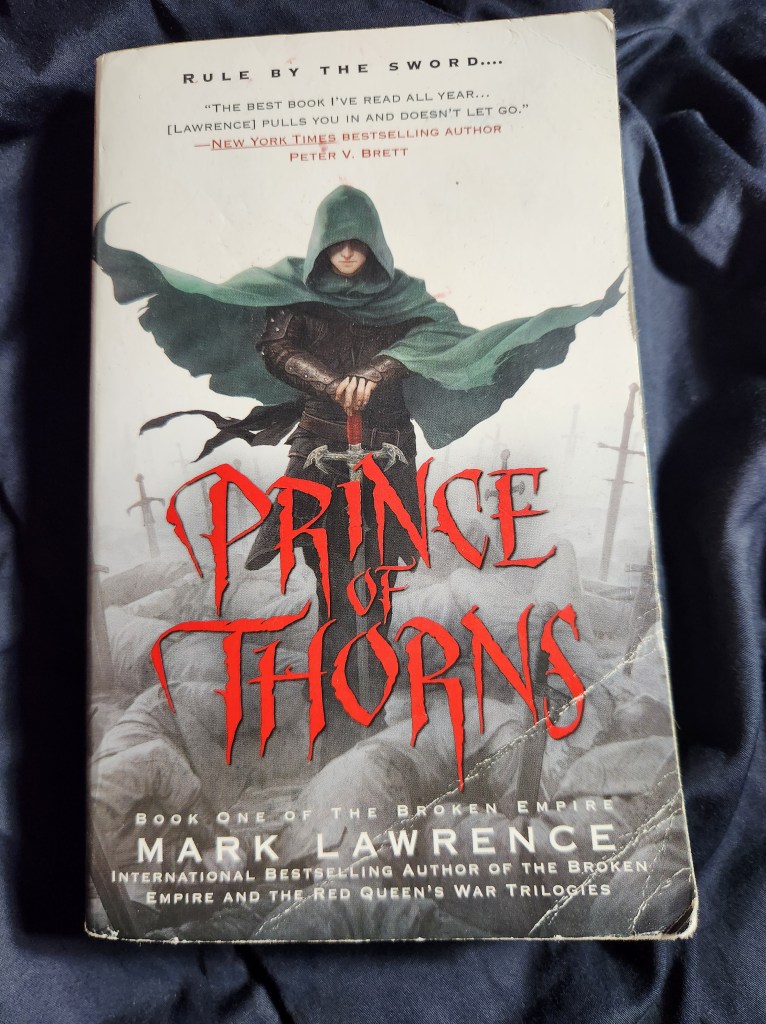
THE FANTASTIC CRIMES OF THE PRINCE OF THORNS

Hi, hi, hi there, droogies! We’re gonna have a look at Mark Lawrence’s Prince of Thorns, a clockwork orange of a fantasy novel, chock full o’ medieval ultra-violence. When a friend first turned me on to this novel, giving me an earful on the badass hero with his background of being crucified in thorns and helplessly watching as soldiers massacre his family, he omitted commenting on Lawrence’s startlingly droll prose style. He did highlight that the aforementioned badass, Jorg of Ancrath, is fourteen years old, and hence, combined with the post-apocalyptic medieval slang, he reminds me of Alex from Anthony Burgess’s dystopian novel A Clockwork Orange.

But Prince of Thorns, in addition to its innovation, remains a solid sword-slashing fantasy novel. Though it tosses in the spices of a post-nuclear war landscape fraught with mutants and magic mixed with weird science in just the right amount of flavor, its main thrust builds on the foundation of a combat-filled fantasy quest, of which, like pepperoni pizza, strong ale, and heavy metal guitar solos, the world always needs more. Teenage Jorg leads his gang of miscreants with all of the testosterone-laden hack-and-slash victories and squalid, skull-crushing mishaps readers hope for and enjoy. But these lost boys are more than just bladesmen. The author slowly distills an original take on technology, including witty and nigh Shakespearean dialogue with leftover AIs from the pre-apocalyptic world and a foray into how-to-make-a-dirty-nuke-for-reavers.

The plot also carries a generous helping of revenge—Jorg seeks payback for his mother’s and siblings’ deaths and also desires to steal the kingdom from his cruel and abusive a-hole king of a father. I have come to appreciate the fantasy genre’s commitment to certain tried and true themes. Though some might call it cliché, as with the aforementioned pepperoni and ale, I find it guarantees satisfaction when you’re in the mood (which, in my opinion, should be often). The fact that Lawrence pulls off the original stylistic elements with aplomb and what I suspect is firsthand professional knowledge of science and technology is all the more wondrous. The “tech-magic” landscape carries notes of 70’s and 80’s fantasy/sci-fi movies à la Wizards and Gandahar.

Another surprising triumph—at least for this reader—is how Lawrence keeps one’s attention with a first-person novel. I know there are many readers out there who take this in stride and even prefer it. F. Paul Wilson achieves this with style and force in his Repairman Jack series. And yet my inner grimdark curmudgeon often struggles with stories told from a single point of view, preferring to see conflicts from multiple angles (if nothing else, for the sake of not knowing who is going to live and who is going to die). On this point, Lawrence’s style is the key—more than a mere self-interested monologue, Jorg’s stream-of-consciousness musings and understanding of his motley gang of companions deliver pathos and empathy in surprising places. Whether it’s generating sympathy for Rike, a demented goon of a man similar to Burgess’s Dim, becoming too damaged to take fingers and pillage quite like he used to, or getting you to cheer on pyromaniac mutant children that make Martin’s Joffrey look like a day-tripper, he keeps you riveted to each unfolding moment until you realize you’ve finished the glass and can’t think of anything but a refill.

Fortunately, there are two more books in The Broken Empire Trilogy—I plan on imbibing them all.

Carl R. Moore is the author of Slash of Crimson and Other Tales, Mommy and the Satanists, and Chains in the Sky, published by Seventh Star Press. He has published numerous short stories in magazines and anthologies, most recently with Jumpmaster Press and Crystal Lake Entertainment. His new novel, Red December, will be released in June, 2024.

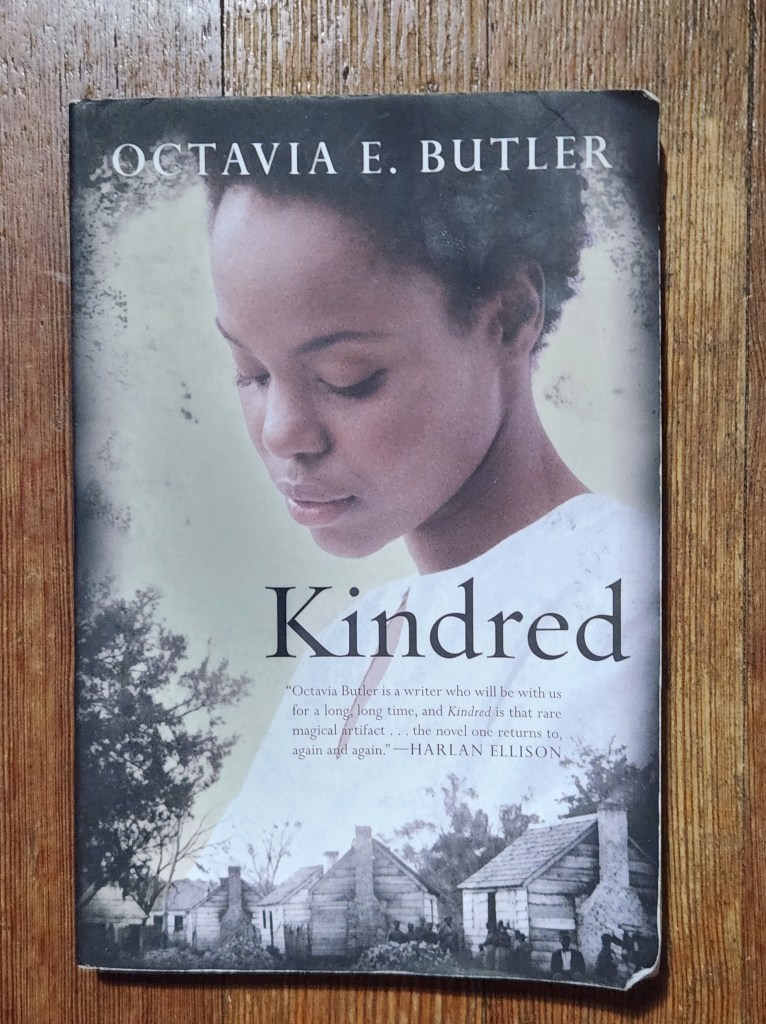
OCTAVIA BUTLER’S KINDRED

I’m excited to get the Deep Dark Night blog started again and will soon have an announcement of exciting events on the horizon. For now, I hope folks enjoy some thoughts on Octavia Butler’s classic Kindred.

I’ve reviewed Octavia Butler’s books before and always find her style to be close to my heart—like George R.R. Martin or Marc Behm, she has an edginess to her voice that defies attempts to make her safe. While her themes certainly thwart injustice with their critiques of present and historical power structures and cruel institutions, she also describes deeper existential issues with regard to family and the human capacity to reinvent morality moment by moment to suit not only survival, but to excuse greed and even evil, against one’s better judgment.

In the case of Kindred, I think it possible a reader might overlook title’s multifaceted nature, but in truth, the kin to whom it refers, the family which the young African American woman of the 1970’s travels time to the antebellum south to interact with, consists not only of the oppressed but the oppressors. This is not just a novel of the thirst for justice and a better world to come; it is a story of the intensity of emotions surrounding necessary parricide and the difficulty presented when a part of a person can’t help but feel a warped affection for their abuser. It handles not only the physical constraints the slaveholders impose, but the insidious kinds of brainwashing they gradually inflict on their victims.

Butler’s works are always courageously complex when it comes to relationships. The Xenogenesis series (possibly my favorite of her works) casts the mid-twentieth century American phobia of aliens invading our land for the purposes of breeding in a light that tints away from 1950’s “they want our women” into a twisting tale of forced evolution, of hallucination-laced sexual interaction with vaguely plant-like beings, and most importantly, the sentiment that when cultural change arrives, it affects every aspect of life and perception—physical, psychological, emotional, and even reproductive. Though generations seek to reproduce themselves, the opposite is always true—change is permanent, and never purely good or evil—only profoundly different.

In the case of Kindred, narrator Dana and her white husband Kevin, a pair of married twentieth century writers, find themselves dealing with the sudden necessity of living in the early nineteenth century under the yoke of the Weylin family, gun toting, disease-ridden plantation owners who handle their slaves like possessions not fully human. Souls and bodies are stretched like tormented victims bound to the rack. Dana allows her husband to present as if he owns her as a means of survival as she navigates a world in which the family’s slaves in the fields, cookhouse, and mansion live in oppression which they despise but to which they are also forcibly accustomed. Even free black woman Alice, whom Dana discovers is her direct ancestor, is sucked deeper into the maelstrom of oppression when she loses her freedom trying to help her husband flee to the north.

Dana discovers that surviving her time travel hinges on keeping the Weylin family’s heir Rufus Weylin alive long enough to have a child with captured Alice. Rufus purports to love the person he has imprisoned. The antonym of Stockholm syndrome, Alice can barely hold onto her sanity as she lives hating Rufus, and Dana comes to realize that this pair, her distant grandparents—her kindred—are the storm that brought about her existence. While she openly defies and criticizes the Weylin family for their cruelty and their embrace of the plantation’s violent practices, her heart and mind experience dizzying emotions surrounding her familial connection to them. There is a nauseating kind of rapport that develops between her and Rufus— she has a power over him that only a strange version of familial love can create.

Motifs involving parricide and family tragedy have always pervaded all forms of literature. From Oedipus to Tyrion Lannister, the nausea of loving and hating a family malefactor is the recipe for the desperate lessons our tales teach. The lesson in Kindred adds and underscores a more terrifying reality to this scheme—that the family violence can be institutional. Built into the very fabric of the American tapestry and the bones of our citizens is that slave and slaveholder are family—are kindred—and while Martin’s Tyrion Lannister may have shot his father in the privy with a crossbow, one or one thousand quarrels cannot shoot away the reality that we cannot murder our history and cannot remove, cancel, or delete the status of kinship. Bodies can be destroyed, but relationships remain and have to be dealt with. To feel the loves and hatreds that come with the storms of history is to feel them not about someone else or other, but about our ancestors and ourselves.

When Butler’s heroine Dana returns to the twentieth century, she passes through a wall that amputates her arm, ironically leaving a part of herself forever in the past. Thus, the novel ends by bestowing a reminder that, though injustices within institutions and families can come to reckonings, and though those who deserve it can be punished, such acts never come without sacrifice and, ultimately, the connection to kindred can never be fully severed.

Carl R. Moore is the author of Slash of Crimson and Other Tales, Mommy and the Satanists, and Chains in the Sky, published by Seventh Star Press. He has published numerous short stories in magazines and anthologies, most recently with Jumpmaster Press and Crystal Lake Entertainment. His new novel, Red December, will be released in July, 2024.