
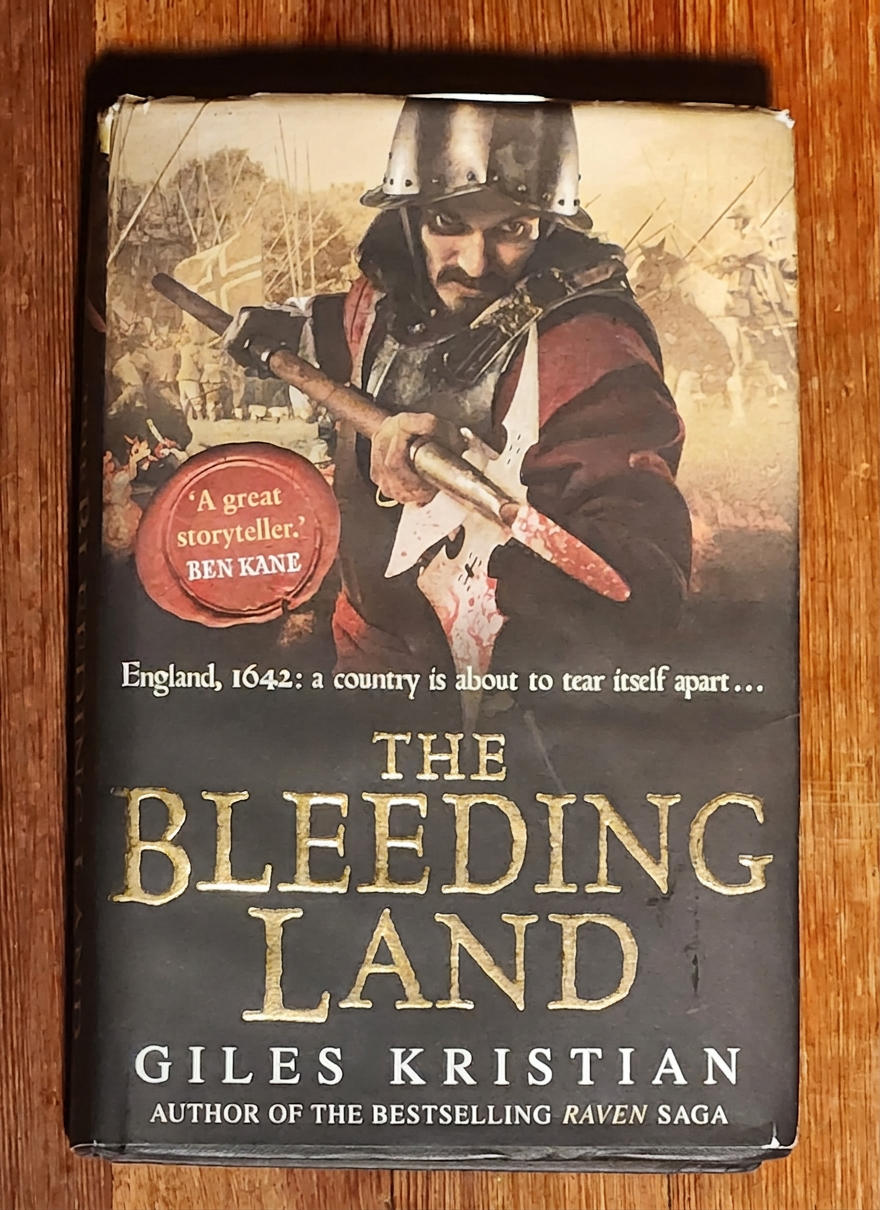
If you grew up in the United States and attended public school, you got an earful of Abraham Lincoln and the Civil War. If you also watched a lot of TV shows and movies, you took in a lot of stories about World War II. There is good reason for this. Both of these wars are pivotal historical events. One can also make an argument that in each case, there are clear good guys and clear bad guys.
Historians and college sophomores may refute you and start listing facts about how the American Civil War wasn’t really about freeing bonded servants and the allies in World War II made plenty of money off arms sales to both sides and even caused that catastrophe to happen in the first place. These points, however, will always fail to overcome the popular perception that these wars were about fighting the evils of slavery and mass murder, and these events will always thus be fodder for straightforward stories enjoyed by all, if at times, and with the less articulate efforts, between yawns.
Yet there are other segments of history’s vast tapestry that do not lend themselves as well to fairy-tale perfect interpretations. Times where major factions in conflicts don’t so clearly hold the moral upper hand. Situations where those who champion a given tender ethic do so while keeping a boot on the neck of the weak. Times where the oppressed wave the banners of golden yet cruel-hearted figures with, as Yeats put it, “passionate intensity.”
In 1642, a small island nation in the North Atlantic experienced its own brutal episode known now as the English Civil War. Oliver Cromwell, a petty aristocrat turned religious zealot, led a puritan-inspired rebellion against the purported tyrant-king, Charles I. Cromwell theoretically championed a democratic parliament against a leviathan of a monarch who unfairly taxed and controlled the country’s citizens. The king also stood accused of infringing on religious freedoms. His detractors alleged he condemned puritans who wanted to reform Christianity into a belief system that stripped away formal institutions and stated a desire for a more direct relationship between humanity and the divine.
On the other hand, in order to achieve his success, Cromwell invented something called The New Model Army, a fighting force of stalwart soldiers with their hair clipped short, their armor fixed to a clone-like standard, and their cannons and muskets aimed at their infidel enemies. Beyond King Charles and his armies, these included Christian denominations they held in contempt (so much for religious freedom). One might say it was as close to a robot army as the Seventeenth Century could produce, which earned their epithet, the “roundheads.”
In opposition, the so-called tyrant king and his Royalists rode about the countryside with the king’s nephew, the dashing Prince Rupert. Rupert’s men were called “cavaliers,” and with their pop-star fabulous long curly hair, feathered hats, and deadly accuracy with a carbine, they championed the right for Britain to keep its swagger, drink ale on Christmas, and generally rock-and-roll.
Nineteenth Century artist William Shakespeare Burton illustrates the contrast between the war’s opposing cultures in his painting, The Wounded Cavalier (or as I like to call it, “A Rocker’s Good for a Fling as Long as You’re Married to the Iron Fist of the Winning Side, Praise Be!”)
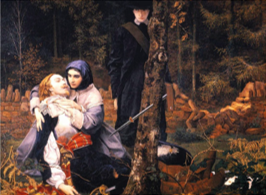
Ironically, it is the conservative “rebel” who holds his sword as if castrating the wild and crazy soldier of the “oppressor.” Yet, both sides in this conflict have their brands of love for authority.
As long as you recognized King Charles was boss and favored his brand of religious oppression, you could ride with the freewheeling(ish) cavaliers.
And if you didn’t, you could join the Parliamentarians…
…as long as you recognized Cromwell and The New Model Army as boss, fought those who they dubbed heretics, and loved the freedom to enforce strict dress codes and austere morality.
Author Giles Kristian’s novel The Bleeding Land paints a literary portrait of such gray ethics in vivid color. The first in a series of historical novels set during the famed Seventeenth Century conflict, the story focuses on a family of Royalists, Sir Francis and Lady Mary Rivers, their sons Edmund and Tom, and their daughter, Bess.
The story begins with parliament’s handling of the Grand Remonstrance, a document drafted by King Charles’ opponents detailing their grievances and accusing him of abuse of power. Though it may be said this document is the spark that lit the war’s powder keg, the story does not dwell on the details of the politics. There being no clear example of mass murder or enslavement as mentioned above, the author instead focuses on the family’s personal stories set against the erosion of British culture’s sense of law and civility.
Kristian plants the seeds of a brother-against-brother plot wherein younger Rivers brother Tom is insulted and attacked by another noble family, the Dentons. Lord Denton has a low-level clergyman executed based on accusations of practicing the wrong kind of Christianity. Said clergyman happens to be the father of Martha, Tom’s beloved. When Denton commits a second atrocity by assaulting Martha and causing her to take her own life, Tom becomes bent on revenge.
The novel draws a clever arc of conflict within conflict. While Sir Francis Rivers and his family rally to the Royalist cause once the king rejects the Grand Remonstrance, it is not loyalty to politics that causes one among them to defect to the Parliamentarian camp. Instead, Tom Rivers simply wants to destroy the Royalist lord who took away the love of his life.
The author might have chosen a plotline more overt in its political ethics. Similar to “good guys versus bad guys” plots common to stories about the American Civil War or World War II, he might have simply painted either King Charles or Oliver Cromwell as a heinous villain to evoke the audience’s sympathies. But such a story would neither be true to history nor as effective as a study of human behavior in a time of complex political ethics.
Instead, Tom Rivers chooses to rebel against the crown not for the sake of establishing a more righteous society, but rather, to inflict pain on those who wronged him. We experience the tension between the even-tempered and purportedly responsible father, Sir Francis and his loyal older son, Sir Edmund, and the younger Tom Rivers who forces all to reckon with the primacy of emotion over reason.
Tom’s rage serves not only to make him a kind of “anti-hero,” but also casts a grim mirror on the romance of the cavalier culture of aristocratic England. The fact Lord Denton can commit a brutal assault on Martha without facing any legal consequences calls into question whether there was any “reason” in such a system in the first place. As the story develops and the opposing brothers prepare for the climactic battle of Edgehill, the audience can justifiably believe that Tom’s rage is a reasonable reaction to a corrupt system.
Yet the Parliamentarians do not possess a monopoly on the audience’s sympathies. While the men of Shear House are away from home with their armies, Lady Mary and daughter Bess face a siege of their own. A small parliamentary force led by a captain Miles Downing demands to seize their home and steal their resources. They seek not only to capture the aristocrats’ assets, but the livestock and property of the farmers on the surrounding lands. Lady Mary organizes a defense not just for the house and her pregnant daughter Bess, but also to protect the local community from lawlessness and plunder.
While The Bleeding Land does not delve deeply into the religious conflicts and prejudices of the time, it succeeds in depicting characters beset on all sides by a deluge of socio-political complexities. One gets the sense that the details of the grievances between king and parliament are themselves a kind of villain. The political arguments eat at the characters’ souls, and by the time the Battle of Edgehill occurs, most of those fighting appear to be doing so for personal reasons that take priority over philosophical ideals (though part of the tension, as exemplified by older son Edmund’s unwavering loyalty to the king, is that he is still motivated by a sense of honor; he does his duty despite showing his rebel brother certain mercies that would be considered treasonous).
The novel proves that the psychological dilemma of choosing between two potential oppressors leaves little room for hundred-percent happy endings. If there is any consolation, however, it also offers keen insight into the human capacity for love and heroic action in the face of the tragic. I propose that we might even seek out the study of such periods in history as a more useful analogue for contemporary America than using the same old villains over an over again and trying to fit them into our discourse. How tiresome has it become that no matter what point of view we take in a political debate, the other side is always Hitler?
For the sake of those who may consider reading The Bleeding Land, I will not discuss the ending here. Suffice it to say, Kristian sustains the sense of ambiguous ethics throughout the entirety of the story, while still offering satisfying conclusions arrived at by the characters themselves. Perhaps that is all any of us can hope for when seeking justice, to know that we can find what is right within our hearts, if not always without.
Carl R. Moore is the author of Slash of Crimson and Other Tales, Mommy and the Satanists, Chains in the Sky, and Red December, published by Seventh Star Press. He has published numerous short stories in magazines and anthologies, most recently with Jumpmaster Press and Crystal Lake Entertainment.

