
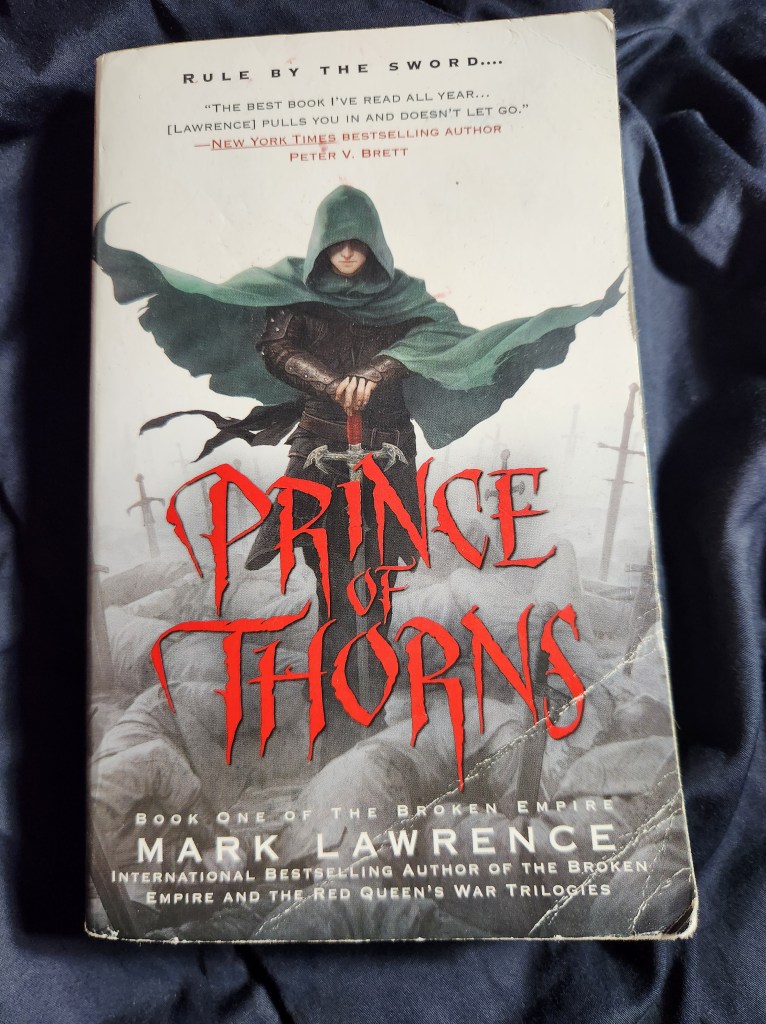
Hi, hi, hi there, droogies! We’re gonna have a look at Mark Lawrence’s Prince of Thorns, a clockwork orange of a fantasy novel, chock full o’ medieval ultra-violence. When a friend first turned me on to this novel, giving me an earful on the badass hero with his background of being crucified in thorns and helplessly watching as soldiers massacre his family, he omitted commenting on Lawrence’s startlingly droll prose style. He did highlight that the aforementioned badass, Jorg of Ancrath, is fourteen years old, and hence, combined with the post-apocalyptic medieval slang, he reminds me of Alex from Anthony Burgess’s dystopian novel A Clockwork Orange.
But Prince of Thorns, in addition to its innovation, remains a solid sword-slashing fantasy novel. Though it tosses in the spices of a post-nuclear war landscape fraught with mutants and magic mixed with weird science in just the right amount of flavor, its main thrust builds on the foundation of a combat-filled fantasy quest, of which, like pepperoni pizza, strong ale, and heavy metal guitar solos, the world always needs more. Teenage Jorg leads his gang of miscreants with all of the testosterone-laden hack-and-slash victories and squalid, skull-crushing mishaps readers hope for and enjoy. But these lost boys are more than just bladesmen. The author slowly distills an original take on technology, including witty and nigh Shakespearean dialogue with leftover AIs from the pre-apocalyptic world and a foray into how-to-make-a-dirty-nuke-for-reavers.
The plot also carries a generous helping of revenge—Jorg seeks payback for his mother’s and siblings’ deaths and also desires to steal the kingdom from his cruel and abusive a-hole king of a father. I have come to appreciate the fantasy genre’s commitment to certain tried and true themes. Though some might call it cliché, as with the aforementioned pepperoni and ale, I find it guarantees satisfaction when you’re in the mood (which, in my opinion, should be often). The fact that Lawrence pulls off the original stylistic elements with aplomb and what I suspect is firsthand professional knowledge of science and technology is all the more wondrous. The “tech-magic” landscape carries notes of 70’s and 80’s fantasy/sci-fi movies à la Wizards and Gandahar.
Another surprising triumph—at least for this reader—is how Lawrence keeps one’s attention with a first-person novel. I know there are many readers out there who take this in stride and even prefer it. F. Paul Wilson achieves this with style and force in his Repairman Jack series. And yet my inner grimdark curmudgeon often struggles with stories told from a single point of view, preferring to see conflicts from multiple angles (if nothing else, for the sake of not knowing who is going to live and who is going to die). On this point, Lawrence’s style is the key—more than a mere self-interested monologue, Jorg’s stream-of-consciousness musings and understanding of his motley gang of companions deliver pathos and empathy in surprising places. Whether it’s generating sympathy for Rike, a demented goon of a man similar to Burgess’s Dim, becoming too damaged to take fingers and pillage quite like he used to, or getting you to cheer on pyromaniac mutant children that make Martin’s Joffrey look like a day-tripper, he keeps you riveted to each unfolding moment until you realize you’ve finished the glass and can’t think of anything but a refill.
Fortunately, there are two more books in The Broken Empire Trilogy—I plan on imbibing them all.
Carl R. Moore is the author of Slash of Crimson and Other Tales, Mommy and the Satanists, and Chains in the Sky, published by Seventh Star Press. He has published numerous short stories in magazines and anthologies, most recently with Jumpmaster Press and Crystal Lake Entertainment. His new novel, Red December, will be released in June, 2024.
 Deep Dark Night