Stories of Venus


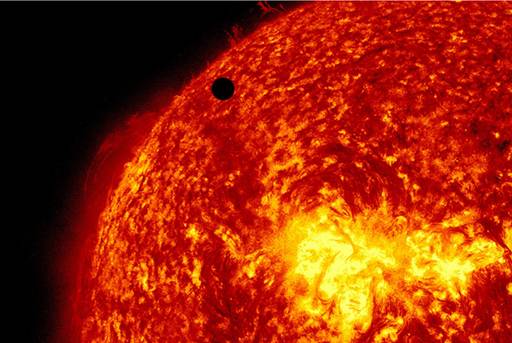
Photo Credit: NASA/SDO, AIA Licensing link here.

So Venus passed in front of the sun. It made me recall what might be one of my favorite Stephen King stories of all time titled I Am The Doorway.  A tale a touch Lovecraftian yet with King’s sense of realism in the prose. It also featured the planet Venus (though it wasn’t quite in the foreground in the story, it cast an ominous shadow over the entire narrative). I read this when I was about nine years old (way too young for it), got pretty freaked out and have been re-reading it now and again ever since.

This also got me thinking that though Mars seems to figure more frequently in science-fiction, horror and fantasy, I personally have always had an interest in the planet that travels between the Earth and the sun. For one thing, Earth and Venus are about the same size, which makes the second planet kind of a warped twin of the third. Something about that and the fact that it is overheated and hell-like serves to feed the dark side of imagination. And if it’s named after a love goddess, that only adds to its sadistic allure.

So I wonder if anyone else has any recommendations on good Venus stories? Has there been an anthology of Venus stories? Would be interested in people’s thoughts.

On another note, something else I should mention is that soon this blog will be featuring some guest bloggers: Armand Rosamilia, writer and editor for Rymfire Books which just published my novella Slash of Crimson will be making a guest appearance, as will Dan O’Brien, author, editor and radio host. Updates soon on when these events will be happening.

Slash of Crimson Available on Amazon.com

Here is a link to the Kindle version now available on Amazon.com (click image below):


Great deal at $2.99, and even if you don’t have an e-reader, it can be downloaded on a laptop or read online.

And of course, anyone who takes the time to give it a (good) review has my undying gratitude!

Thanks and enjoy,

–Carl

Slash of Crimson Release by Rymfire Books

So today’s the day, Rymfire is releasing Slash of Crimson. I will post links to booksellers as they become available; it may not be up on Amazon.com until tomorrow. Also, the book will be available in ebook format first and the paperback release possibly a week away yet. For folks who’d rather wait for the paperback, that’s all good; I invite anyone to try out the ebook format on Amazon, however, as it will cost significantly less.

Here’s what some advance readers had to say about it:

Slash of Crimson brims with a sensual grittiness that is every bit as hypnotic and captivating as its mysterious heroine. Fans of Joe Hill or Neil Gaiman will appreciate Moore’s keen knack for description and atmosphere that all comes together in a contemporary gothic tale that sinks in its claws on the very first page and doesn’t let go even after its thrilling conclusion.” — Allison M. Dickson, author of Dust

Slash of Crimson is a fun read with a climax that caught me totally off guard. Carl Moore has crafted a must for anyone who cares about reading good books or just reading…period.” —Brent Abell, author of In Memoriam (forthcoming)

Again, I’ll be posting links to booksellers as they come in. For now enjoy a look at the official cover, and thanks in advance to all readers:

Atlantis

A nice article on the origins of Atlantis from the BBC website:

http://www.bbc.co.uk/history/ancient/greeks/atlantis_01.shtml

This myth has been on my mind during these days leading up to the release of Slash of Crimson, as it figures largely in the storyline. Though there have been wide ranging theories as to origins of Plato’s sunken city, I think its location probably does match a geographical source from the classical or pre-classical Mediterranean. Discovering a story’s origins, however, often raises more questions than it answers.

We are conditioned by themes in popular literature to feel like we already know to some extent what kind of character a vampire has, a werewolf has, etcetera. We need these themes to stay somewhat true even to enjoy it when we add a twist to them. And so in this regard, when it comes to Atlantis, what we’re usually handed is an ancient civilization inhabited by advanced beings that encountered tragedy for unspecified reasons.

But I wonder sometimes what motivations might lie beneath this story structure. I wonder what an Atlantean would have to say about Plato’s tale, and whether what he thinks important would be the same as what she thinks important. Perhaps an Atlantean would have other priorities entirely. Perhaps she would ask something very different of someone she loves, for example, than a human would, and perhaps growing to understand what that love truly meant would lead to places uncharted indeed.

A Game of Phones

In an age where technology is splicing itself faster than a mad scientist’s Petri-dish full of mutant mitoticidal bunny rabbit cells, I sometimes forget about a device that existed long before blackberries, iPads and Skype. That is, the telephone.

During the weeks Armand (Writer/Editor with Rymfire) and I were sending drafts of Slash of Crimson back and forth, the emails started to get a little backed up. I kept sending him versions with names something like, Slash.of.Crimson.REAL.FINAL.VERSION.I.MEAN.IT.THIS.TIME.WITH.ACKNOWLEDGMENTS.doc

As a result, we had to work out version control. We also had to discuss the final touches on the cover. And of course, the release date. This was going to take a lot of time through email, and increase traffic even more.

That’s when Armand came up with a radical proposal: “How about you call me?”

Carl: “Okay, no problem, let’s see, why don’t you email your phone number…”

Omitted: “…to my Gmail account which will automatically forward to my Blackberry (well, it’s not really a Blackberry, it’s a Nokia E71x that looked almost as cool as a Blackberry about eight years ago, but hey who’s counting…). Anyway it’ll come in as a text message and I can just save your number from there.”

Armand: “Sure.”

But of course when would the call happen? Because after all, one of the great advantages of texting and email, of beaming photos back and forth and posting things on social networking sites, is the time lag. You can respond when you have time to respond and get more done overall. Most of the time this works perfectly for us as we are pretty busy with full time writing schedules and other responsibilities. But finally we settled on our first phone call attempt:

Thursday night, 9:00 p.m.:

Carl’s email at 11:30 p.m.: “Crap, I’m really sorry, I fell asleep putting the kids to bed and forgot to ask Sarah to wake me up.”

Armand’s email: “No worries, how about next Friday?”

The Next Friday:

Armand’s email: “NOT TONIGHT—family duties, try next week.”

Carl’s email: “No problem.”

Omitted: “…I mean, it works out anyway because I had like three shots of bourbon and some hot wings and can’t talk. No, not a scheduling issue. I mean I can’t talk.

The Next Sunday:

Armand’s email: “I called this afternoon.”

Carl’s email: “So did I.”

Omitted: Guys, phone calls have to happen simultaneously.

Next Thursday:

Carl’s email at 11:30: “Crap, um, I fell asleep putting the kids to bed again, crap, damn, sorry…”

Armand’s email: “Oh, yeah, um, I was asleep too, but I woke up from about 9:00 to 9:05.”

Carl’s email: “Okay, we’re going to make this happen tomorrow morning.”

Friday morning:

I began to realize that the phone call had to be made a true priority. All kidding aside, the reality is that I function under a set of priorities similar to those listed in Stephen King’s On Writing. Namely, that the most important thing about the craft of writing is to write every day, rain or shine. Nor does it matter if it’s a holiday or day-job day, sleep-deprivation day (or night), or a kids or housework day. All must be worked around. This is the way forward in developing one’s craft as a novelist. This is the way to become a better storyteller. The advice in that book, which is generally echoed by other professional novelists, proves true in a lasting sense.

Where that particular book is less useful, however, is in pointers in more recent forms of networking and conducting business. In a time when Internet and Ebooks are alive and getting stronger, we can’t ignore this side of writing. And though I would still never sacrifice the daily work on the craft, this other realm must also be developed.

And so that Friday morning I delayed the camping trip departure, delayed the bill paying, delayed even getting dressed. And though I didn’t cut out the writing session altogether, I did put aside some time at the end and made sure the phone call was finally on time!  An hour later Armand and I had our details worked out.

Thus, Slash of Crimson’s release date:  June 1, 2012!

On Wildernesses

Upon returning from a recent trip to the woods I found myself thinking about the true meaning of ‘wilderness’. As a writer, I’ve noticed most of my stories take place in either remote rural landscapes or deep in the inner city. This reflects my own biography, having spent most of my adult life living in large cities and most of my youth living in back-woods Maine. Of course, Stephen King has written quite a lot about Maine, and many diverse aspects of it. Yet I would venture to say, even as a fan of his writing, that in most cases, the way he engages Maine and Mainers could be characterized as ‘Small Town’ Maine. I think he has always done this exceptionally well, and growing up in Bangor during his time of coming to prominence as a novelist would be an interesting post in itself.

However, I’ve always felt like there was something else going on in my relationship with the locale where I grew up. I’m not talking so much about the small towns, but rather the remote lakes, streams and forests where my father spent as much time as he could, and where consequently, I spent a large amount of time during my formative years.

These places had a character that wasn’t quite so state-specific. Rather, I felt a sense of losing touch with mapped geography altogether and travelling back to something primordial. Being at the winter lake and listening to the ice bend and crack through the night, being at the summer lake and hearing the coyotes wailing far off in the hills had a limitless, impersonal kind of power. When we were in these places, we did not have running water or electricity, and often ate food that was hunted, gathered or caught. As a child this breadth of land and closeness of life and death had a profound impact on my mind. We were not church-going people and the old man rarely talked about impractical things. To the extent I heard anything close to spiritual, it centered on what animals had to do to survive. However, I would stop short of saying that nature itself was ‘spiritual’; instead I would substitute ‘nature’ with ‘wilderness’. I would consider wilderness a place where independence and survival constituted what was most important, and the landscape something to be tampered with only to the extent minimally required to facilitate survival’s priorities. True, animals and human beings living in these settings sometimes worked in groups, but there was a distinct sense of independence and thrift when it came to relationships that was nothing like what one experiences in day to day life in more civilized places.

Jump cut to my move to big cities—I have lived mostly in two large cities: Pusan, South Korea, and New York, New York, and for now will focus on New York.

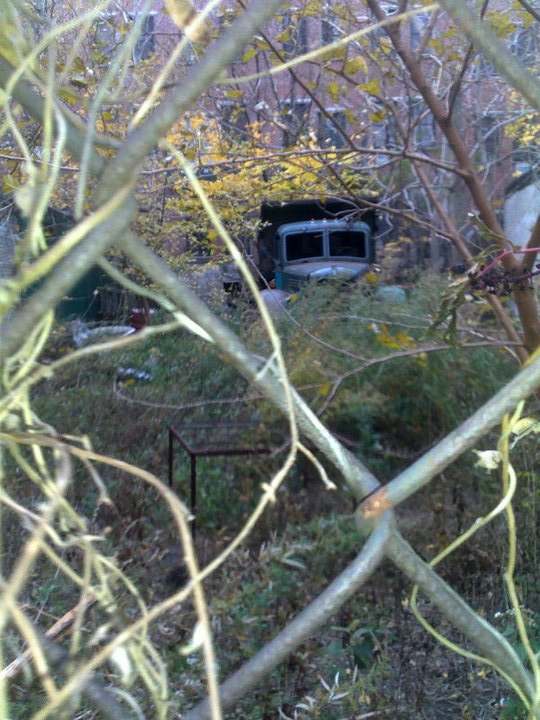
When I began living in Brooklyn, I felt a stir very similar to what I felt when I would go to the remotest parts of Maine. Maybe that sounds crazy, because Brooklyn is so densely populated. But it did feel somehow familiar. Perhaps one factor might have been that the neighborhoods where I could afford to live were mostly impoverished, particularly when I first moved to the city in the late 1990’s. The doorways were thick with graffiti, the lots slithering with weeds and the carcasses of old cars. Most of us are familiar with scenes like these because many American cities have their own versions of them. But what took me aback about New York was the sheer size of it. Its immensity made it feel like an urban tundra—a place uncharted and not subject to the rules and regulations common to smaller cities, towns and suburbs.

And so wilderness began to take on a new meaning for me, something that consisted of what Maine and New York had in common—the sense of mystery, the sense of lawlessness and the sense of freedom. Whether urban or rural, these landscapes possessed a certain rugged power that could enliven narrative, particularly when dealing with subjects frightening or taboo. And though the setting alone would never be the whole of a story, venturing into lands ripe for exploration increased the chance for a thrilling discovery.

The Evolution of an Image: On Co-Creation with One’s Spouse

Note: due to the nature of some of the early versions of the cover image contained in this post, reader discretion is advised.

Slash of Crimson’s publication date nears. The cover is finished. But getting to this point was a more involved process than I expected.

When Rymfire first accepted the manuscript, I wondered what their method was for acquiring cover art. Being a small press, they often worked with both new writers and new artists. It became quickly clear to me that it could be a fair amount of work to find the right fit for any given project. I asked editor Armand Rosamilia if he would be open to my getting involved in the selection process. He said he was so long as the work was high quality and matched Rymfire’s brand.

And so the search began—I turned first to a New York artist who had given me a business card on the subway. It showed a painting of a subway car, mostly blacks and grays, with tentacles slithering out of its windows. They were poised to seize an unsuspecting elementary school student and drag the body into the one spot of color, the creature’s red mouth. The sinister threat combined with a macabre sense of humor attracted me and I contacted him. He was interested, however, he had already moved from one tier of the art world to the next, going from home studio to Brooklyn gallery shows. His price had therefore increased to something that, if it couldn’t buy you an Andy Warhol print, it would at least qualify as a decent down payment on one.

Next I tried an old friend from Portland, the city where the novella takes place. He was willing to do it and sent me an amazing painting. However, though a beautiful work in its own right, it was very abstract and wasn’t quite the hard rock style that matched Rymfire’s brand, publishers of books like Heavy Metal Horror and Extreme Undead.

And so I was beginning to feel like Goldilocks (albeit a black bearded manson-jesusish sort of Goldilocks). Nothing was quite right. I began to brood and stew around the house, until I finally went to an artist who happened to be quite close by—my wife Sarah—and asked if she would be interested in working up an image herself.

Now someone might wonder why I didn’t go to Sarah in the first place. Wouldn’t that be convenient, an artist in the family who would always be willing to co-create? Except that Sarah and I had never worked together on anything. Indeed, though not expressly stated, we tended keep our art very separate during our lives together. While we had definitely shared our work with each other from the time we met, and generally liked each other’s work, giving each other room to do our own work was a boundary we didn’t want to blur.

Sarah’s artistic background consisted of art school in Virgina and then Queens College in New York City. She had already lived in New York as an artist for over ten years when we first met. While her themes did at times include the macabre, her work usually employed video as its media and focused on gallery-oriented post-modernism. I guess the analogy in writing would be what’s popularly considered the distinction between ‘genre fiction’ and ‘literary fiction’.

On the other hand, I knew she knew how to draw, and so figured why not just hit her up and see if she’d make an exception to our usual practice:

“Honey, I was wondering if you could draw a creepy naked woman who just crawled out of the ocean for my book cover?”

“I suppose I could take a shot.”

“That’d be great, remember it’s a horror/dark sci-fi novel, so think along the lines of The Exorcist meets Aliens.”

“Um, what?”

“Right, maybe think along the lines of something like Japanese cartoons.”

“You mean the porno ones?”

“Kinda.”

“All right, I’ll take a shot.”

Now aside from the thematic considerations we have our all encompassing and most profoundly important consideration, that is, the schedule of our family life. Many writers have talked about this, from Virginia Woolf to Stephen King. I don’t want to do that entire essay here, but suffice it to say that what we normally do is take turns doing activities with the kids so that the other person can have some personal time. This of course has to be done outside of a full time work schedule, and with the added consideration that one of our daughters is not yet in school and still requires constant care.

Therefore the fair division of time and tasks is critical to harmonious domestic life. Again without going to far into these issues, most of the time I try very hard to make a full contribution and not do my personal work at the expense of my family. How successful I am is not for me to say, though I haven’t been thrown out yet. What changed, however, when the cover art came into play, was that I would simply have to give up some of my writing time to give Sarah time to work on the cover. I would also have to take the kids more often to give her extra time on top of that to work on it. And I did this as well as I could, and out of all the factors of ‘what it is like to work with a spouse on an art project’, I would say that in our case, this is the most important. Working with my spouse on an art project consists mostly of pushing swings, doing dishes, driving kids around and helping them when they don’t quite make it to the bathroom in time…

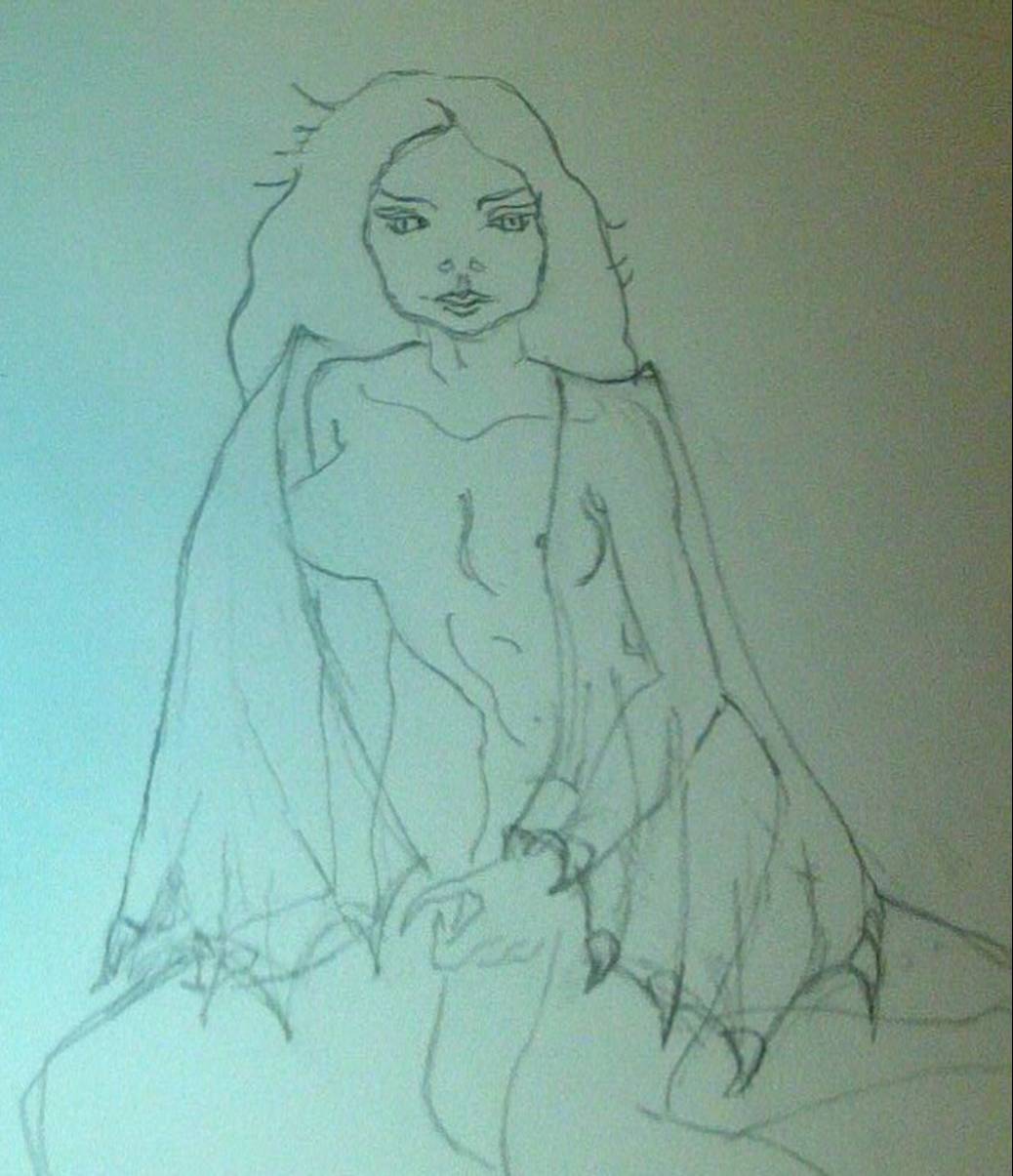
But even with those obstacles accounted for, there were still important aesthetic considerations. What kind of image would she use? We started by reading some passages from the book. She agreed the inciting incident, the opening scene where the kayaker is rescued by the woman who emerges from the waves, was what she wanted to draw.

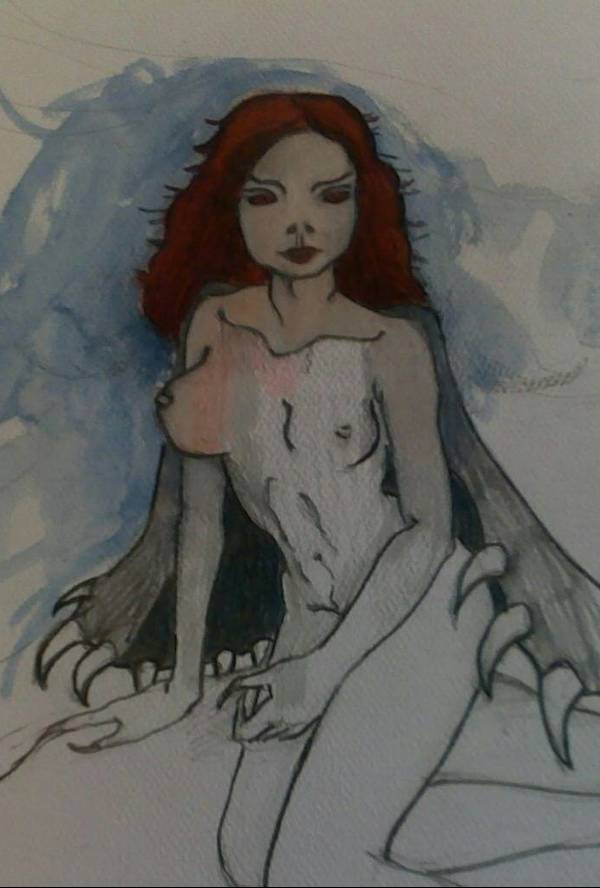
She went with a good mix of eeriness and allure and thus her first rendering looked like this:

Of course I liked it, but also knew, as confirmed by editor Armand, that bare nipples could be objectionable on a lot of the websites where the book would be for sale. Neither I nor Armand had anything against nipples personally, but we knew it just wasn’t conventional in genre fiction to put them on a book cover.

Me: “I’m sorry, I think we’re going to have to cover the nipples.”

Sarah: “What’s wrong with nipples?”

Me: “They’re naked. I mean it has nudity, so mainstream booksellers won’t show the image on their websites.”

Sarah: “But I thought you guys were bad-ass heavy metal dudes.”

Me: “Um, maybe, but the booksellers are pretty important.”

Sarah: “You know, in art school there were naked people all over the place, it was no big deal.”

Me: “I know, but genre fiction usually goes with the scantily clad and well-armed.”

Sarah: “Like guns?”

Me: “Yeah, like guns, like guns okay, nipples not okay. I actually like guns and nipples, but that’s just how it goes…”

Sarah: “Okay, I’ll cover the nipples.”

Thus the next version:

“What do you think?”

“I love it but there’s still half a nipple.”

“You can barely see it.”

“Right, we have to just not have the nipples, like even though the novella itself is rated R, the cover just has to be PG-13.”

“You know, in Europe they had bare breasts all over the magazines, everybody seemed okay with that. And when I was taking figure drawing I discovered porno mags had some of the best photos of the human body. I often used to sketch from those, like the big butt ones were the best for that.”

“Yeah, I guess this gal’s not even fully human, more on the skeletony side…”

“Yeah, I think Grandma’s Hollywood actress mags have better models for that. But I’ll have to go with a composite, photos and a live model.”

“As long as you like the image in the end. My suggestions are just suggestions. I want this to be a work of art you would stand behind.”

“Of course. I wouldn’t do it otherwise.”

There ensued more discussion, mostly about color and light, but as much as I tried to lay my back-seat-driving sort of opinions on her work, we deferred to her sense in the end, since she is experienced and I trusted it would come out best that way.

And thus, the final version:

Now, in what manner Rymfire will design the final cover is yet to be determined. As stated by the editor, there are considerations to publishing standards for the layout of the text and the title, etc. There will be some cropping and sizing involved and possible touch up in Photoshop.

In the end however, I am truly indebted to Sarah for coming up with such a gorgeous cover that captures the spirit of the novella. Perhaps it may even inspire someone to buy a paperback version of the book and acquire something that is interesting to look at, as well as interesting to read.

Has anybody else ever worked with his or her spouse on a project? I’d be curious to hear how it went!

–C.R.M.

Cover Art Completed

In anticipation of the release of the Slash of Crimson, I will be writing a post about what it was like to work with my wife on the book’s cover art. Rymfire recently approved the image, and so that post on our collaboration and the evolution of the image will go up by the end of the week.

For anyone who has not read the original post on Slash of Crimson’s publication announcement it can be found here:

https://carlrmoore.wordpress.com/2012/02/11/slash-of-crimson-debut-novella/

Thanks and check in when the post goes up!

–C.R.M.

Review of Wrath James White’s The Resurrectionist

Wrath James White’s The Resurrectionist occupies a unique niche in the horror genre that combines 1990’s Tarantino over-the-topness and early 2000’s J-Horror emotional mercilessness. It shows an appreciation for the craziest and most violent of slasher films, yet brings with it a desire to mingle such tropes with subtler, philosophical themes. I compare it to movies specifically because the prose style possesses an even more cinematic style than other novels in a genre already known for letting words imitate the camera lens.

White’s hook is the story’s premise itself: what would happen if a serial killer were able to resurrect his victims? He would kill them more than once, naturally. So begins killer Dale McCarthy’s rampage as he sets up shop across the street from the novel’s protagonists, Sarah and Josh Lincoln. At the outset of the story, they are a young relatively happy couple making their way in the tough post-market crash Las Vegas economy. Their own world comes crashing down around them as well, however, when Dale starts killing and raping them every night then resurrecting them before morning.

While the plot may seem like a setup for a gratuitous bloodbath, White adds a subtle edge to the narrative that moves it between the aforementioned Tarantino style killer-kitsch and the constant sense of vengeful revelation of the J-Horror subgenre. He draws a picture of a killer whose habit imitates a stark sort of addiction. Unlike an art-swallowing bodybuilder like Thomas Harris’s Francis Dollarhyde, he gives us a skinny, sweaty suburbanite with the tritest of aesthetic tastes. For Dale McCarthy is no reader of Blake or fetishist who conducts his fantasies to the sounds of Beethoven (as Burgess’s Alex in A Clockwork Orange). No, Dale unleashes his torment on the denizens of pre-fab housing from his own pre-fab lair within the same community, preoccupied only by his pock-marked face, skinny limbs and cheerleadery taste in women.

The strong presence of Las Vegas as a supremely decadent desert city comes through in the novel almost as if it were one of the characters. There is an almost nauseous, funhouse feel to the violence here. The forces at work in the killer’s mind, the forces at work in the victims’ minds as they arm themselves with state-of-the art weaponry and surveillance, and the forces at work in the economy as the housing prices plummet in the development where most of the crimes take place, all carry a kind of up-and-down rollercoaster feel. It is a setting with frightening moods swings.

Though I read a few reviews that seemed concerned with the depth of the characters’ personalities, I think it is an error not to call them complex. To my mind Sarah, Josh and Dale come across as characters very contemporary in their concerns. From protagonist Sarah’s thesis on human sexuality to Dale’s computer-nerd-serial-killer persona, there is a sense that these 21st Century identities are all unapologetically their own. Such attitudes are combined with detailed descriptions of stab-wounds, bullet wounds and dismemberment, as well as intimate thoughts on sex and religion. Thus, though at first glance these characters who delve into the existence of God or peruse porn sites may begin their musings with stock arguments like, ‘How can God create someone so evil?’, the juxtaposition of these motifs, the intermingling of God, sex, and violence builds its quickening rhythm until we find ourselves witnessing a frighteningly accurate description of a large portion of pop-culture’s subconscious. Not pulling punches when it comes to these issues, White portrays a bold and beautiful couple who both benefits from and is trapped by this culture. Their sharp minds and popular good looks may have given them a sense of success and joy, only to be turned around and become the reason they are horrifically tormented.

White comes at all issues concerning body, mind and spirit with a kind of arid honesty. It is here I see the similarity to J-Horror, for The Resurrectionist, like The Ring and The Grudge, does not romanticize the vengeful victim. Though it may not be Dale’s fault he has become what he had become, we do not find ourselves rooting for this kicked around outsider. At best, he is one to be put out of his misery, at worst, he calls into question our popular intellectual culture’s assumptions about jealousy and fairness.

Whatever assessment the reader makes of the killer along the way, it will mutate once more after a surprising and paradoxical climax wherein the sense of helplessness and eternal irony is only increased. However one absorbs this final assault, it’s a sure bet this author’s ideas and fresh storytelling style will be worth revisiting.